Are You Failing the POPAT? You're Probably Training for It Wrong.
Are You Failing the POPAT? You're Probably Training for It Wrong.
Published on Nov 11, 2025 | By Training Club

Why Your "Marathon" Mindset Won't Work for This All-Out Sprint.
For any police applicant, the POPAT (Police Officer's Physical Abilities Test) is the first major hurdle. It's a high-stakes, pass/fail test that stands between you and your career. And for many, it’s a source of massive frustration.
If you're struggling to pass, or if your times have plateaued, you're likely falling into the most common trap: You are training for the POPAT like it's a marathon.
We see it all the time. Applicants run the full, timed course over and over, week after week, just hoping their time will magically drop. But the POPAT isn't a long-distance run. It's an explosive, all-out sprint that demands a combination of speed, agility, and raw power.
Treating it like an endurance event is the single biggest mistake you can make. You end up building a lot of "junk miles" without improving your weakest links.
Let's break down why this approach fails and what you must focus on instead.
The Problem: Why Running the Course Fails You
When you just re-run the course, you're only practicing at your current (and failing) pace. You're not actually getting faster or stronger.
The POPAT is an anaerobic test, meaning your body is working without oxygen for short, intense bursts. Long-distance running is an aerobic (with oxygen) activity. Training the wrong energy system is like preparing for a 100-meter dash by jogging 10k. It's inefficient and can even be counterproductive by training your muscles for slow, repetitive movement.
Instead of this flawed approach, you need to break the test down into its core components. Your training should focus on these three pillars.
Pillar 1. Get Faster (Build Top-End Speed)
The POPAT is fundamentally a test of repeated sprints. You need to be able to accelerate from a dead stop, hit your top speed quickly, and do it over and over.
Hill Sprints: This is one of the most effective ways to build explosive power and perfect your sprint mechanics. The incline forces you to drive your knees and use your arms, all while reducing the impact on your joints.
Resisted Sprints: Attach a sled or resistance band to your waist. Sprinting against resistance teaches your body to produce more force with every single step. This is how you build the "horsepower" to explode off the line.
Top-End Speed Drills: Practice "flying 20s" or "flying 40s"—sprints where you build up speed and then hold your absolute maximum speed for 20-40 meters. You must get comfortable being uncomfortable at a full-out sprint.
Pillar 2. Get Technical (Master Agility)
The POPAT isn't a straight line. Time is lost—or saved—in the transitions. Every turn, every jump, and every change of direction is an opportunity to shave off precious seconds.
Agility & Change of Direction: Practice 5-10-5 shuttle drills or other cone drills. The focus shouldn't be just on running, but on how efficiently you can decelerate into a turn, sink your hips, and re-accelerate in a new direction. This is crucial for the cone weave.
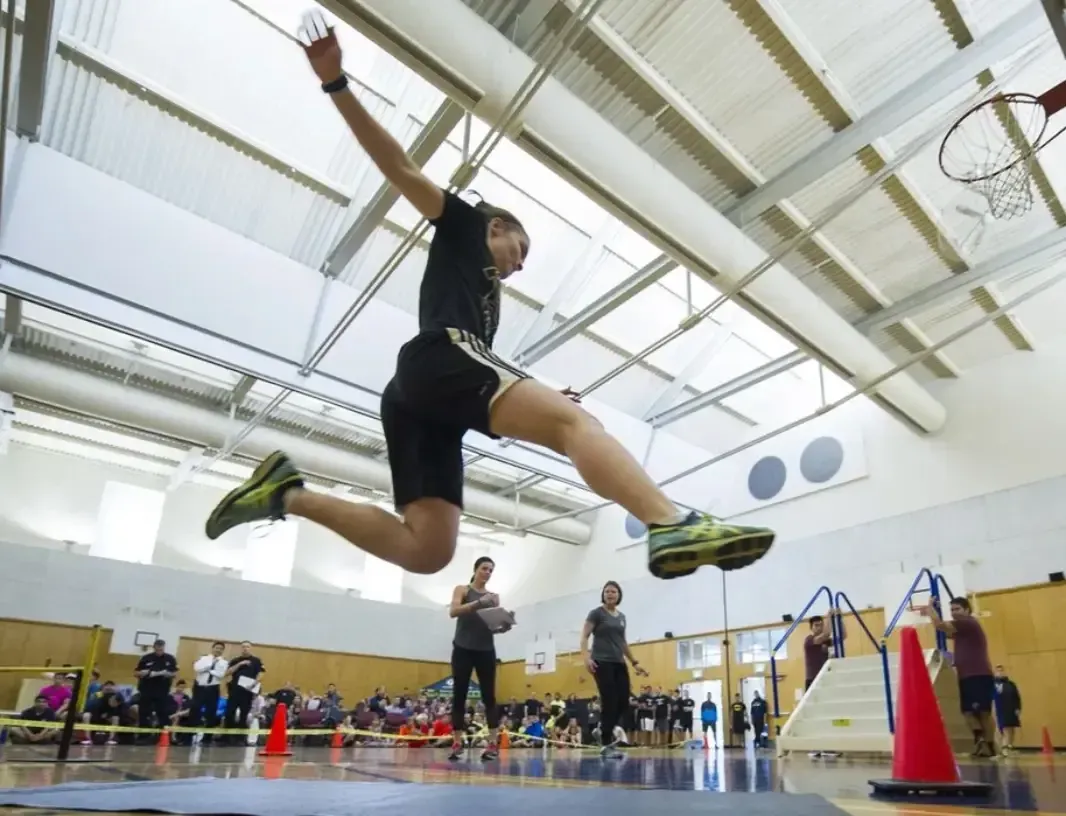
Plyometrics (Jumping): The vault and stair components require explosive power. Integrate plyometric drills like box jumps and broad jumps into your training. These teach your body to produce maximum force in minimum time—the very definition of power.
Transition Practice: Don't just run the full course. Break it down. Practice just the sprint into the stair climb. Practice just the cone weave into the vault. Master each small piece, and the whole puzzle will come together.
Pillar 3. Get Stronger (Build Real Strength)
This is where many applicants gas out. The push/pull machine and the bag carry aren't just tests of strength; they are tests of strength under fatigue.
For the Push/Pull Machine: This is a full-body effort that demands a rock-solid core and powerful legs.
Key Exercises: Heavy sled pushes and sled pulls are non-negotiable. They are the most specific way to train this event. Supplement these with compound lifts like squats, deadlifts, and overhead presses to build total-body strength.
For the Bag Carry: This is a brutal test of grip strength, core stability, and mental toughness.
Key Exercises: Farmer's carries are your best friend. Start with two-handed carries and progress to single-arm carries to challenge your core stability. Add in dead hangs (hanging from a pull-up bar for time) and heavy rows to build a vise-like grip.
The New Mindset: Stop Guessing, Start Training
Don't just run. Get faster, get stronger, and get technical.
Stop wasting your time running the same failed test over and over. A passing grade is too important to leave to chance. You need a real plan that attacks your specific weaknesses and builds you into the explosive, powerful applicant the POPAT demands.
Ready to Pass for Good?
If you're tired of guessing and ready to follow a proven plan, I'm here to help.
Send me a DM with the word "POPAT" and let's get you a real plan to conquer this test for good.
Don't wait to start your career. Request your free, no-obligation POPAT consultation today.
We'll break down your weaknesses and build a plan to get you passing.
Click the link in our bio, fill out our new client contact form, and we'll contact you immediately to schedule your assessment.
